
Tongue tie
in adults
Tongue tie is a structural restriction present from birth. In adults, its impact extends far beyond speech - contributing to jaw pain, headaches, neck and shoulder tension, sleep-disordered breathing, and difficulties swallowing. Many adults reach us after years of symptoms that were never connected to a restriction nobody thought to look for.
A structural restriction with whole-body consequences
Tongue tie is not a condition that resolves with age. The restriction present from birth remains into adulthood, and over decades the body continues to compensate - creating habituated patterns of movement, posture, and tension that extend well beyond the mouth. The lingual frenulum connects through the floor of the mouth, the hyoid, and into the anterior neck and fascial system. Restriction here does not stay local.
Many adults who come to us have never had a tongue tie assessment. They have seen physiotherapists, dentists, ENT surgeons, and sleep specialists. Some have had orthodontic treatment. Many have been told their symptoms are stress-related or postural, with no resolution. When the underlying restriction is finally identified and addressed as part of an integrated treatment pathway, it often explains years of symptoms that were never adequately accounted for elsewhere.

Recognise your symptoms?
Adult tongue tie presents across multiple domains. Many people recognise symptoms in several categories simultaneously. Select the area most relevant to your experience.
- Adult · JawJaw pain and TMJ problems→
- Adult · Head and neckHeadaches, neck and shoulder tension→
- Adult · SleepSnoring and sleep apnoea→
- Adult · SwallowingDifficulty swallowing→
- Adult · BreathingMouth breathing and open mouth posture→
- Adult · DentalDental crowding, gum recession and bruxism→
- Adult · SpeechLisp, articulation or speech speed→
- Adult · EatingDifficulty moving food and chewing→
- All ages · Missed diagnosisTongue tie missed in infancy→
- All ages · RevisionPrevious release that didn't resolve symptoms→
Not sure which applies? View all symptoms by age group or book a free Concerns Call.
Our approach for adult patients
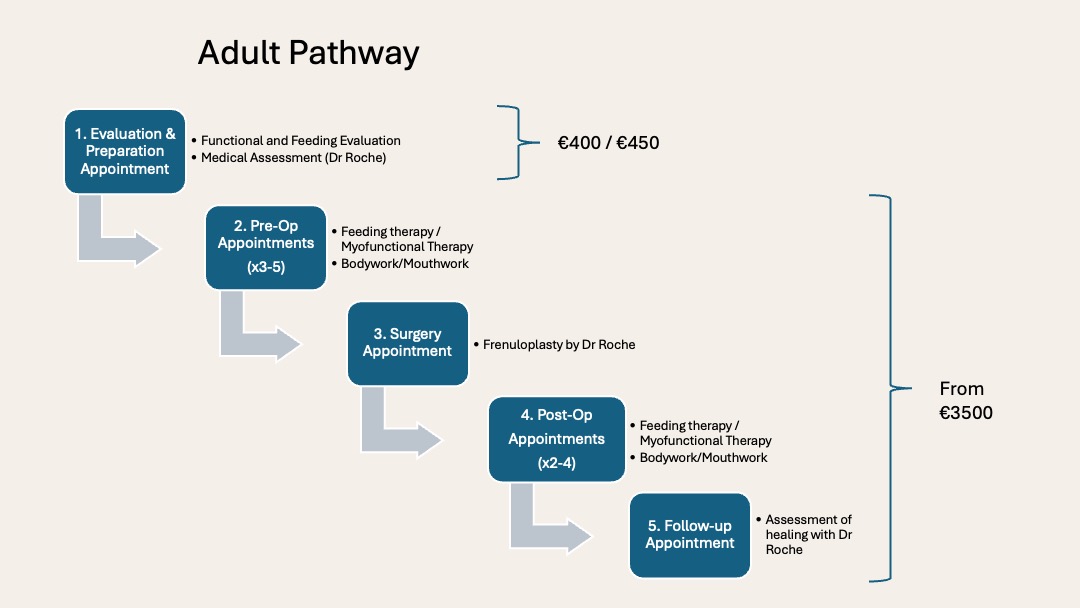
The adult pathway follows the same integrated structure as our other age groups - assessment, preparation, surgery, and rehabilitation - but is tailored to the specific presentation and goals of adult patients. Decades of compensation require a thorough approach to rehabilitation. The procedure itself is performed under local anaesthetic with no requirement for sedation or general anaesthetic.
Comprehensive Assessment
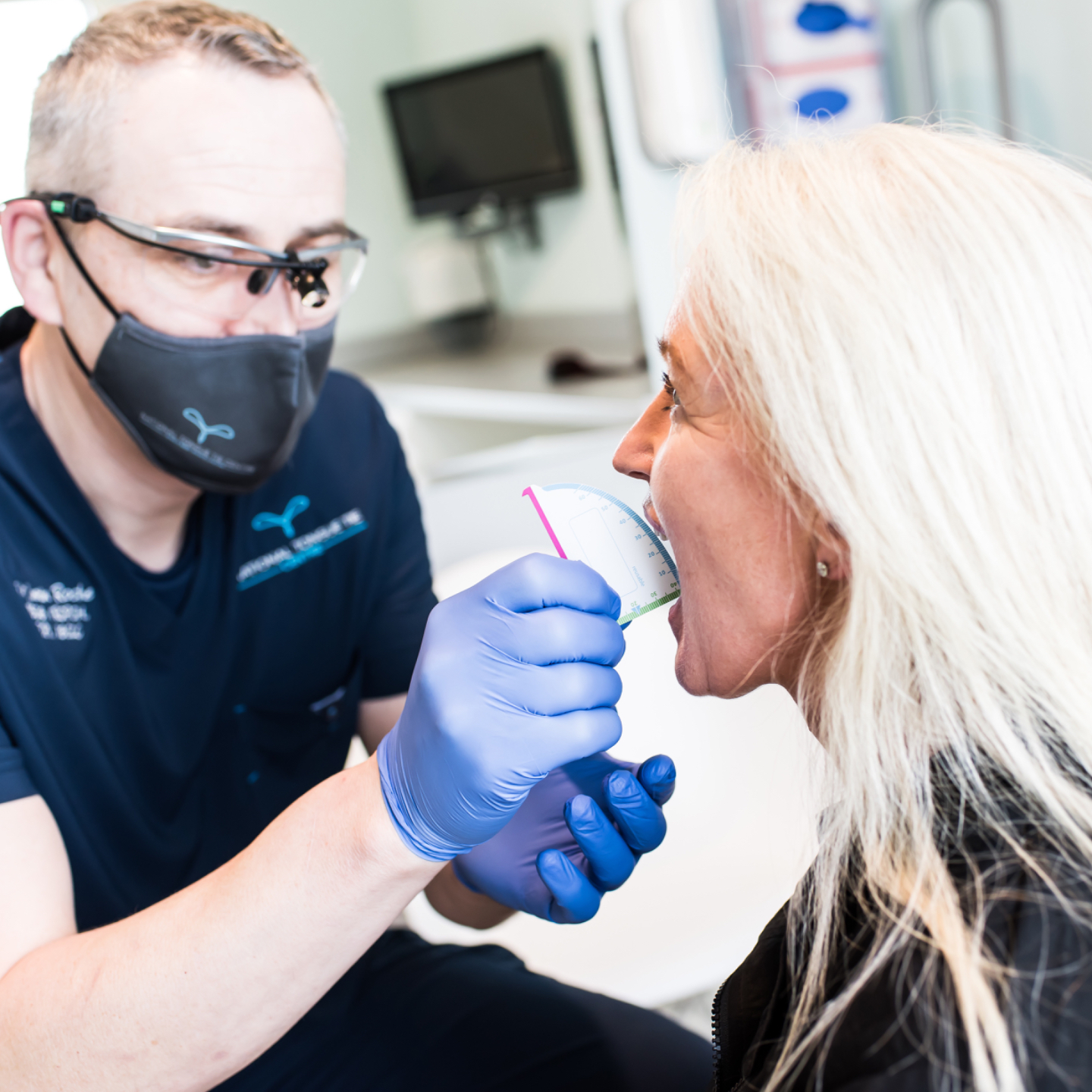
The initial assessment is a detailed functional evaluation - nothing surgical takes place at this visit. One of our chartered physiotherapists will assess your oral function, looking at tongue range of motion, resting posture, swallowing pattern, jaw mechanics, and any compensatory adaptations that have developed over time. For adults this assessment is often more complex than in younger patients, as decades of compensation have typically resulted in layered patterns across multiple body regions.
This is followed by a medical consultation with Dr. Justin Roche, Consultant Paediatrician, who will examine the oral tissues and discuss the combined clinical findings with you. We will tell you honestly whether we believe a functionally significant restriction is present, what we think is contributing to your symptoms, and what we recommend. We do not recommend treatment unless we are confident it is indicated. You are not committing to any procedure by attending.
What to expect at the assessment
The physiotherapy assessment involves observation of tongue movement, assessment of jaw and neck mechanics, and a postural evaluation. It is thorough and unhurried. The medical examination follows, and the appointment concludes with a full discussion of findings and recommendations.
Nothing surgical takes place at the assessment appointment.
Pre-operative Myofunctional Therapy and Physiotherapy
Before surgery, we work with you to prepare the tongue, jaw, and surrounding musculature. This serves two purposes: it begins the process of normalising movement patterns that have become habituated over years, and it provides us with clinical information about how much of your restriction is structural versus compensatory - refining our approach to the procedure itself.
For adult patients, the pre-operative phase often involves myofunctional exercises targeting tongue strength, stamina, and range of motion; physiotherapy addressing jaw, neck, and fascial tension; and swallow retraining where relevant. This phase is clinically significant, not a formality. The quality of preparation directly influences the quality of the outcome.
Functional Frenuloplasty under Local Anaesthetic
The procedure is performed under local anaesthetic. You will be awake throughout. Because you are conscious during surgery, we can ask you to perform tongue movements in real time - this allows us to assess tone and function during the procedure itself and gauge precisely how much tissue requires release for optimal function.
The surgical site is closed with absorbable sutures, meaning no active wound management is required at home post-operatively. Doctor and physiotherapist work together in surgery, ensuring all aspects of the restriction are addressed. The procedure takes approximately 30 to 50 minutes to complete.
This is what differentiates functional frenuloplasty from simpler releases: the precision of assessment and release guided by real-time functional testing, within a pathway that prepares the patient before surgery and consolidates the outcome afterwards.
Post-operative Rehabilitation
Releasing the restriction creates the structural possibility for normal tongue function. The rehabilitation work establishes it in practice. For adult patients, post-operative rehabilitation is typically more intensive than for younger patients, as the compensatory patterns requiring correction are more deeply established.
Our therapy team works with you on continued myofunctional exercises, swallow retraining, physiotherapy for jaw and neck, and wound care review. We monitor the surgical site through the healing period and adjust the programme based on your progress. Where you are working with other practitioners - a physiotherapist, speech and language therapist, or dentist - we are happy to liaise directly.
Patients who engage consistently with the post-operative programme achieve significantly better functional outcomes. The procedure without the rehabilitation is an incomplete treatment.
Common questions from adult patients
If you don't find what you need here, our free Concerns Call is the best next step.
I'm in my 30s / 40s / 50s. Am I too old for treatment?
There is no upper age limit for assessment or treatment at the National Tongue Tie Centre. We treat adults across all age groups. The approach is the same regardless of age, though we are honest with patients that decades of compensation typically require a more committed rehabilitation phase to consolidate the gains from surgery. Age is not a barrier - motivation to engage with the full pathway is what determines outcomes in adult patients.
I've had a tongue tie release before and it didn't help. Would a revision be worthwhile?
This depends on what was done previously and what remains. We see many adults who had a release - either as a child or more recently as an adult - without adequate assessment beforehand or rehabilitation afterwards. In some cases there is residual restriction that was not fully released. In others, the restriction was adequately released but the compensatory patterns were never addressed, so functional improvement was not achieved. We will assess your current functional status honestly and advise whether further intervention is indicated.
Will the procedure hurt?
The procedure is performed under local anaesthetic and you will not feel pain during it. There is typically some discomfort in the days following surgery, manageable with standard analgesics. Most adult patients report that the post-operative discomfort is less than they anticipated. The absorbable sutures mean no wound management is required at home. We will give you full information on what to expect before you proceed.
My jaw pain / headaches / neck tension have been attributed to stress or posture for years. How do I know if tongue tie is relevant?
The honest answer is that a specialist assessment is the only way to determine this reliably. Tongue tie cannot be assessed or ruled out without direct clinical examination of oral function and range of motion. We will examine your tongue, assess the fascial and muscular connections, and give you our honest clinical opinion. If we do not believe restriction is contributing to your symptoms, we will tell you that. We do not recommend treatment unless we are confident it is indicated.
Do you treat adults with sleep apnoea related to tongue tie?
Yes. The tongue's resting posture is directly relevant to airway patency during sleep. A restricted tongue that cannot achieve a correct resting position against the palate can contribute to collapse of the posterior airway during sleep, snoring, and obstructive sleep apnoea. We assess this as part of the standard evaluation and, where relevant, include airway and breathing retraining as part of the post-operative rehabilitation. We recommend that patients with a confirmed sleep apnoea diagnosis continue to work with their sleep physician alongside our treatment pathway.
How long does the full pathway take?
The timeline varies depending on your presentation and how quickly you progress through the pre-operative preparation phase. A realistic expectation for most adult patients is several weeks of pre-operative therapy before surgery, followed by a structured post-operative rehabilitation programme. We will give you a specific expectation at the assessment appointment once we have assessed your individual situation.
I've had orthodontic treatment. Does that affect assessment or the procedure?
Previous orthodontic treatment is relevant history and we will take it into account during assessment. In many cases, orthodontic relapse after completed treatment is a sign that the underlying tongue restriction was not addressed - the tongue's resting pressure against the teeth continued to exert the same forces as before. Addressing the restriction and retraining correct tongue resting posture can help to stabilise orthodontic outcomes. We recommend letting your orthodontist know if you are planning to proceed with frenuloplasty.
Transparent fee structure
The initial evaluation is a standalone clinical appointment - you are not committing to any procedure by attending, and the findings and recommendations from this appointment are clinically valuable regardless of whether you proceed to surgery.
Comprehensive functional assessment, medical consultation, clinical findings and recommendations. No obligation to proceed.
Pre-operative myofunctional therapy and physiotherapy, functional frenuloplasty under local anaesthetic, and post-operative rehabilitation.
A payment plan is available. If you hold private health insurance, please see our fees page for information on what may be covered. Contact us if you need documentation to support a claim.
Ireland's original dedicated tongue tie clinic
Established in 2010 as Ireland's first clinic dedicated entirely to the assessment and treatment of tongue tie. Led by Dr. Justin Roche (Consultant Paediatrician, FRCPCH, FRCPI, IBCLC) and Kate Roche (Chartered Physiotherapist, IBCLC, Feeding Therapist). Clinics in Clonmel, Co. Tipperary and Kildare.
Ready to understand what is really happening?
If you have been living with symptoms across multiple domains - jaw, sleep, neck, swallowing, speech - and have not found a satisfactory explanation, a specialist tongue tie assessment may provide the clarity you have been looking for. We will evaluate fully, explain what we find, and give you an honest recommendation.
Clinics in Clonmel, Co. Tipperary and Kildare. Patients seen from across Ireland and internationally.
Frenuloplasty is a surgical procedure. All procedures carry associated risks, and individual outcomes vary. Full information on risks, benefits, and realistic expectations is provided at assessment before any decision to proceed is made.