
A referral pathway built around your patient
The National Tongue Tie Centre offers multidisciplinary assessment and treatment for ankyloglossia across all age groups. We welcome referrals from GPs, IBCLCs, paediatricians, SLTs, orthodontists, osteopaths, and allied health professionals.
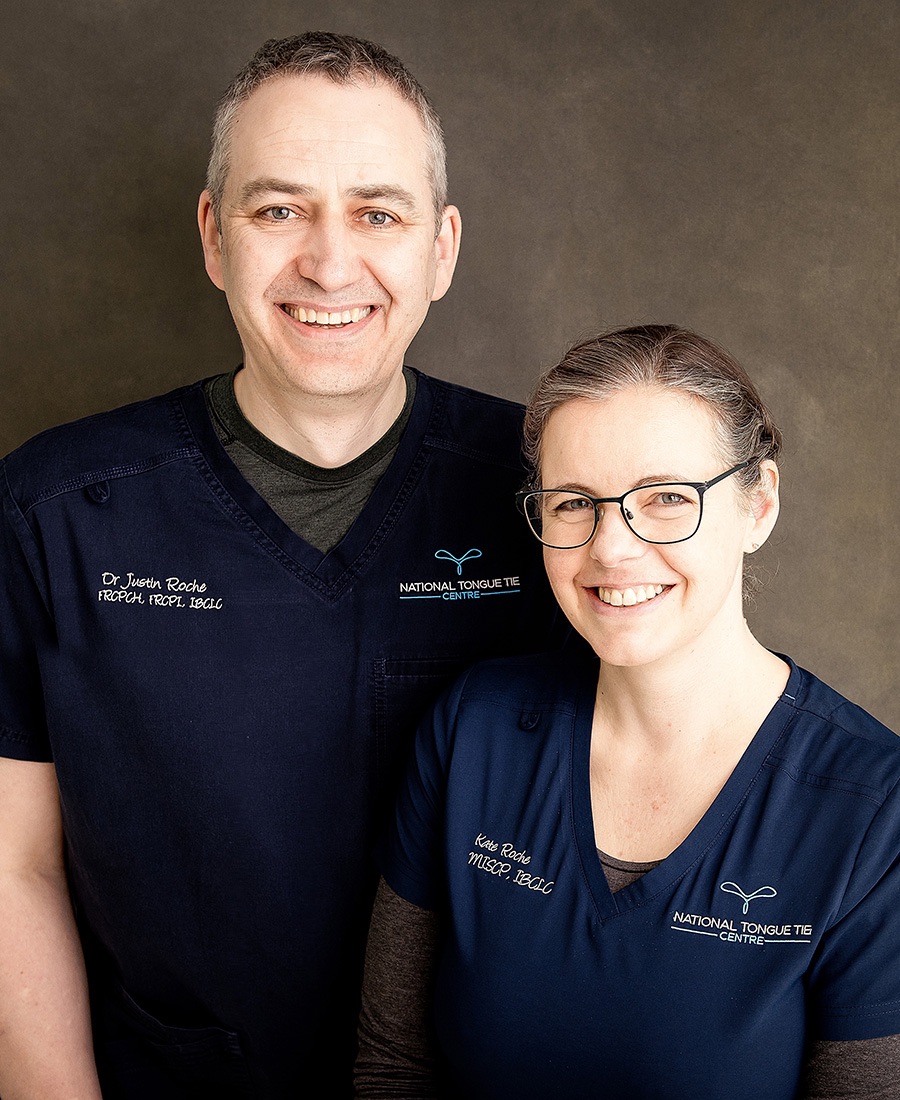
Multidisciplinary care, not single-operator assessment
The NTTC has been in clinical practice since 2007, and was established in 2017 on the principle that tongue tie cannot be adequately addressed by release alone. Structural assessment and functional rehabilitation must occur together, with every patient seen by a clinician who integrates both.
Our model combines consultant paediatric expertise with physiotherapist-led feeding and oral motor therapy, delivered as a co-ordinated clinical pathway rather than a sequence of separate appointments.
Release Restrictions. Retrain Function. Relieve Tension.
Our three-part clinical philosophy underpins every assessment and treatment pathway, regardless of patient age or presentation.
CO2 laser functional frenuloplasty
Performed by Dr. Justin Roche (MB ChB, FRCPCH, FRCPI, IBCLC). We do not perform scissors frenotomy. The functional frenuloplasty technique is designed to optimise range of motion and tissue healing outcomes.
Physiotherapist-led rehabilitation
Led by Kate Roche (BSc Physiotherapy, MISCP, IBCLC, Feeding Therapist). Pre- and post-procedure functional work addresses feeding patterns, motor patterning, and oral function across all age groups.
Fascial and myofascial assessment
Where clinically indicated, we co-ordinate with osteopaths, craniosacral therapists, and bodyworkers to address tension patterns along the deep front line before or after release.
Who can refer - and for what
We accept referrals from all healthcare professionals, and patients can also self-refer directly. A formal referral letter is not required. Below are the most common referring professions and the typical presentations they refer for.
GP / General Practice
General Practitioners
- Infant feeding difficulties
- Failure to thrive or slow weight gain
- Persistent reflux or colic
- Adult jaw pain, headaches, neck tension
- Sleep-disordered breathing in adults
- Post-orthodontic relapse
Midwifery / PHN
Midwives and Public Health Nurses
- Breastfeeding pain or poor latch not responding to support
- Nipple trauma or damage
- Infant not gaining weight adequately
- Suspected posterior tongue tie at newborn check
- Maternal feeding distress
Speech and Language Therapy
Speech and Language Therapists
- Persistent articulation difficulties with restricted tongue mobility
- Plateau in speech progress despite therapy
- Suspected lingual restriction contributing to dysarthria
- Dysphagia assessment in adults
- Children discharged with residual difficulties
Orthodontics / Dentistry
Orthodontists and Dentists
- Post-orthodontic relapse
- Restricted tongue posture affecting palate development
- Open bite with suspected tongue thrust
- Bruxism in context of restricted oral function
- Pre-orthodontic tongue tie assessment
- Gum recession with high labial frenulum attachment
IBCLC / Lactation
IBCLCs and Lactation Consultants
- Suspected tongue or lip tie not resolving with positioning and latch support
- Maternal nipple pain and damage
- Infant feeding aversion
- Recurrent mastitis or blocked ducts
- Low milk supply with suspected mechanical cause
Physiotherapy / Manual Therapy
Physiotherapists and Bodyworkers
- Persistent jaw or neck tension with suspected oral restriction
- Infant postural asymmetry with feeding difficulty
- Adult TMJ dysfunction not resolving with standard physiotherapy
- Sleep-disordered breathing with suspected tongue restriction
If you are unsure whether a patient is appropriate for referral, contact our clinical team directly before making a formal referral.
The referral and treatment pathway
No referral letter is required. Patients may self-refer or be referred by a clinician. The assessment is conducted from first principles regardless of any accompanying documentation.
Referral or self-referral
Patients book directly via tonguet.ie or are referred by a clinician. A letter is welcome but not required. Note whether you wish to receive a written report.
Combined assessment
The initial appointment includes both feeding therapy assessment and medical review in a single integrated session, using standardised instruments where age-appropriate.
Clinical decision
Recommendations are made on the day based on functional findings. Not all patients proceed to release. Where indicated, frenuloplasty is typically performed at the initial appointment.
Rehabilitation and review
All patients receive a structured rehabilitation plan with follow-up included. A written summary is provided to the referring clinician on request, with patient consent.
Our pathway - what to tell your patient
Understanding what your patient will experience at NTTC helps you refer with confidence and prepare them appropriately. Our approach is integrated and multi-stage - it differs significantly from single-appointment release services.
We do not recommend surgery unless we are confident it is clinically indicated. If we assess a patient and believe surgery is not warranted, we will tell the patient that clearly and provide a written assessment summary. Referral to us does not commit your patient to a procedure.
Download the NTTC referral form
Complete the referral form and return it to Dr. Justin Roche via HealthMail at [email protected]. No referral letter is required alongside this form. A written clinical report will be returned via HealthMail on request.
How to submit
- Complete the form in full — typed or handwritten
- Confirm patient consent to share data with NTTC before sending
- Send as an attachment via your HealthMail client
- Address to: [email protected]
- We will confirm receipt and contact you to arrange the appointment
Conscious sedation service
For patients unable to cooperate with the procedure under local anaesthetic alone - including older infants, toddlers, and children with anxiety, sensory sensitivities, or complex presentations - we offer a conscious sedation pathway.
This service is provided under the medical supervision of Dr. Justin Roche, who holds consultant paediatric credentials and extensive procedural sedation experience in children. It significantly expands access for patients who would otherwise require general anaesthesia.
Learn more about this serviceSuitable for referral via this pathway
- Children aged 6 months and over where cooperation under local is unlikely
- Patients with autism, ADHD, or significant sensory processing difficulties
- High levels of dental or procedural anxiety
- Patients for whom general anaesthesia has been recommended or is under consideration
- Complex presentations requiring more extensive frenuloplasty
Who your patients will see
The founding team remains clinically active and involved in direct patient care. Every patient at the NTTC is seen by experienced clinicians.
Common questions from referring clinicians
Does the patient need a formal referral letter?
No. Patients can self-refer directly. A referral letter is welcome and will be reviewed as part of the assessment, but is not a prerequisite for booking. The assessment is conducted from first principles regardless of documentation provided.
Will I receive a written report after the appointment?
Yes, on request. We provide a written clinical summary for the referring practitioner's records. Please indicate when referring that you would like a copy sent to you, and ensure the patient has consented to this disclosure. Reports are sent by email in PDF format.
Do you treat posterior tongue tie?
Yes. Our assessment is function-led, not grade-based. A posterior restriction producing measurable functional impact on feeding, speech, airway, or orofacial development will be assessed and discussed with the family. We do not decline to assess based on tie classification alone.
What age groups do you see?
We assess and treat patients from birth through to adulthood. Specific pathways exist for newborns (0 to 12 weeks), infants (3 to 6 months), children (6 months and over), and adults. Our conscious sedation service extends access to older infants and children who are unable to cooperate under local anaesthetic alone.
How long is the wait for an appointment?
Wait times vary with demand. Current availability is visible at tonguet.ie/book-appointment. For urgent infant feeding presentations, please contact us directly and we will advise on the earliest available slot or cancellation list placement.
What is your position on the RCPI Faculty of Paediatrics consensus statement?
Dr. Justin Roche and Kate Roche co-authored a published response to the RCPI statement, which appeared in the Irish Medical Times. Our position is that the clinical significance of tongue tie - particularly posterior restriction and its impact on speech, sleep, dental development, and jaw function - is not adequately reflected in current national guidance. We are co-signatories of the 2026 international consensus statement on ankyloglossia.
Can I speak to a clinician before referring?
Yes. If you have questions about a specific presentation, contact our team by phone or through the clinical enquiry form. We are happy to discuss unusual or complex presentations in advance of a formal referral.
What do families need to bring to the appointment?
Families should bring the child's personal health record, any relevant previous feeding or clinical assessments, and - for breastfeeding families - the infant should be available to feed at the appointment if possible. An intake questionnaire is sent on booking confirmation.
Can you liaise directly with my patient's other practitioners?
Yes. We are happy to liaise with GPs, SLTs, orthodontists, physiotherapists, and other practitioners involved in a patient's care, with the patient's consent. For children receiving speech and language therapy, we recommend continued collaboration with their SLT during and after the post-operative rehabilitation period and will communicate directly where this is helpful.
How long is the waiting time for an assessment?
Waiting times vary with demand. Please contact the clinic directly for current availability. For infants with significant feeding difficulties or weight gain concerns, please indicate this when booking and we will endeavour to prioritise accordingly.
Professional education and resources
The Tongue Tie Toolbox is our dedicated educational platform for clinicians working with ankyloglossia across disciplines.
The Tongue Tie Toolbox is the educational platform founded by Kate and Justin Roche, providing structured professional development for IBCLCs, feeding therapists, physiotherapists, bodyworkers, and other practitioners working with tongue tie patients. Courses cover assessment methodology, functional evaluation, pre- and post-operative management, and the integrated care approach developed at NTTC through over two decades of specialist practice.
Explore the Tongue Tie ToolboxThe PRIME Clinical Masterclass introduces the five-element feeding assessment and rehabilitation framework developed by Kate Roche at the NTTC. Relevant for feeding therapists, IBCLCs, and physiotherapists.
Learn about PRIMERefer a patient or make a clinical enquiry
We welcome direct contact from referring clinicians. If you have a complex presentation or want to discuss a case before referring, please use the clinical enquiry route.