
The Tongue Time 2026 Congress Statement: Why It Matters for Families and Clinicians
Apr 02, 2026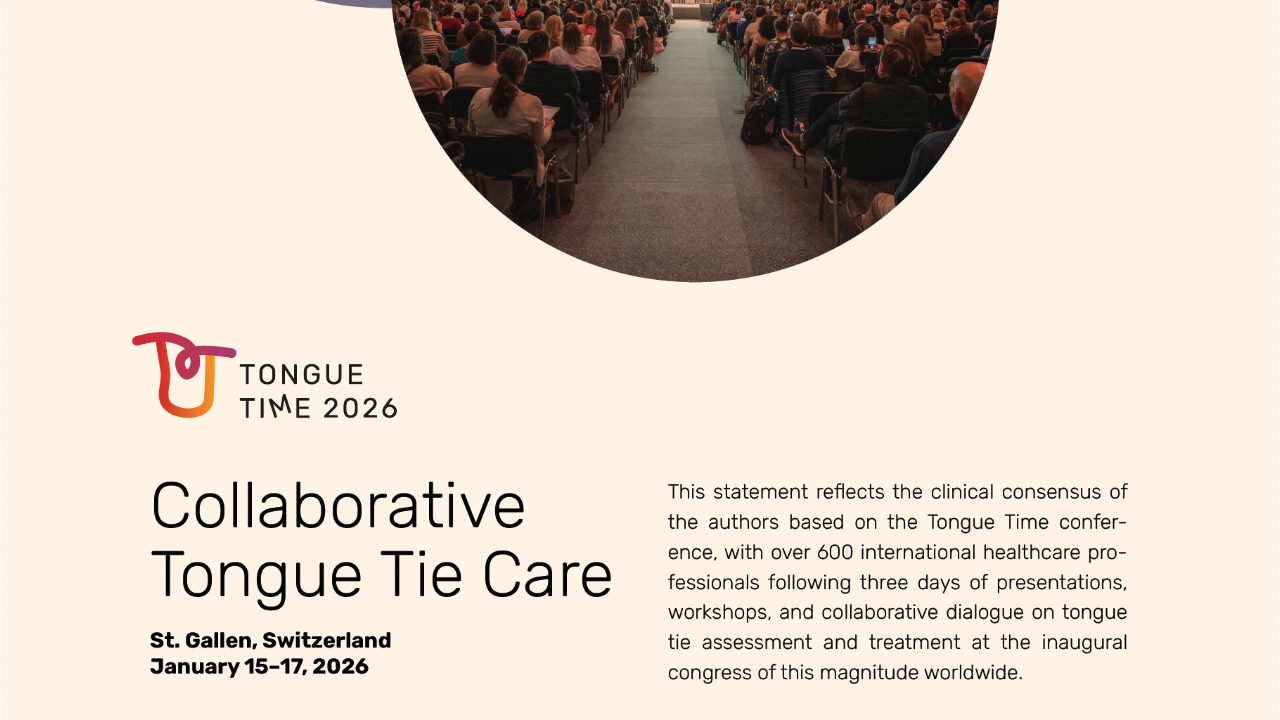
In January 2026, Kate and I travelled to St. Gallen, Switzerland for the inaugural Tongue Time congress. Over three days, more than 600 healthcare professionals from 45 countries gathered to present, workshop, debate, and ultimately agree on something meaningful: a shared set of clinical principles for tongue tie assessment and treatment.
We were part of the writing group that produced the Congress Statement. This post explains what it says, and why it is worth your attention, whether you are a clinician, a parent, or somewhere in between.
What the statement is
The Tongue Time 2026 Statement is a principles document, not a clinical protocol. It was drafted by a multidisciplinary group and reflects the collective clinical thinking of professionals across dentistry, medicine, physiotherapy, lactation, speech-language pathology, myofunctional therapy, chiropractic, osteopathy, midwifery, and occupational therapy.
It is deliberately not prescriptive. It does not tell you how many follow-up appointments to book or which classification system to use. What it does is articulate where the international clinical community stands on the fundamentals of good tongue tie care.
The core message
Tongue tie is a functional condition. That framing matters. The statement is explicit that assessment cannot rely on anatomical appearance or measurement alone. What we need to evaluate is function: how does this person feed, breathe, swallow, sleep, speak, and move? What compensatory patterns have developed? What does the whole body tell us?
As a paediatrician and IBCLC, my assessment approach has always centred on the functional picture rather than the anatomical grade. It is good to see that position reflected in international consensus, backed by clinicians from across every relevant discipline.
Why collaborative care keeps coming up
The statement is clear that no single practitioner holds all the answers. The strongest theme across the entire congress was the value of team-based care. When disciplines work together around a shared functional goal for the patient, outcomes improve. When they work in isolation, they often fall short.
At NTTC, the paediatric and lactation medicine perspective I bring works alongside Kate's physiotherapy and feeding therapy assessment. We also refer regularly: to IBCLCs, myofunctional therapists, craniosacral therapists, ENT, and sleep medicine where indicated. That referral network is not a gap in our service. It is part of the service.
The statement calls on professional organisations to foster collaboration rather than professional territorialism. That is a direct and deliberate line. The tongue tie field has not always been immune to that particular problem.
Release is necessary but not sufficient
One of the clearest points in the statement is that complete anatomical release is required but not enough on its own. Pre-intervention preparation matters. Post-operative therapy matters. Structured follow-up matters.
Parents sometimes ask us why there is so much to the process: the pre-assessment, the bodywork, the exercises, the follow-up. This is why. The procedure itself is one component of a treatment pathway. Without functional rehabilitation, the neuromuscular patterns that developed around the restriction often remain. Anatomical freedom has to be paired with the opportunity to relearn movement.
The lifespan point
The statement emphasises that tongue tie is not just a newborn feeding issue. Early identification and intervention matters enormously, particularly for breastfeeding. But the statement is equally clear that tongue tie assessment and treatment are relevant across childhood, adolescence, and adulthood. Many of the patients we see are older children and adults who spent years with symptoms that were never linked to an undiagnosed restriction: jaw pain, sleep-disordered breathing, difficulties with eating, speech changes, postural tension.
You can access the statement here: https://tonguetime.ch/frontend/index.php or here: https://www.tonguetietoolbox.com/offers/hrJ4w6LJ
If you want further information on training in tongue tie identification and management: https://www.tonguetietoolbox.com/professional-courses
The statement validates what many experienced clinicians already know: it is not too late. Timely intervention at any life stage can produce meaningful functional improvement.
On safety and ethics
The statement gives careful attention to informed consent, proportionality, scope of practice, and adverse event recording. These are not formalities. Informed consent in tongue tie care means being honest with families about what we expect to improve, what may not change, and what the realistic risks are. Proportionality means not over-treating. Scope of practice means knowing when to refer.
At NTTC, our consent process documents functional findings, clinical reasoning, expected outcomes, alternatives, and uncertainties. That is what the statement calls for, and it is the standard we hold ourselves to.
What we hope it changes
The statement ends with a call to action across healthcare systems, professional organisations, individual clinicians, and researchers. For us, the most pressing asks are these: reduce the barriers to timely care, invest in long-term functional outcome research, and move reimbursement away from procedure-only models toward comprehensive assessment and follow-up care.
Families affected by tongue tie frequently face long waits, conflicting information from different providers, and out-of-pocket costs that make comprehensive care inaccessible. That needs to change.
Read the full statement
The Tongue Time 2026 Congress Statement is available at: Congress Statement
If you work in any of the disciplines that touch tongue tie care, we would encourage you to read it and share it with colleagues.
If you have questions about assessment or treatment at NTTC, you can contact us at tonguet.ie.
Dr. Justin Roche MB ChB FRCPCH FRCPI IBCLC Medical Director, National Tongue Tie Centre